
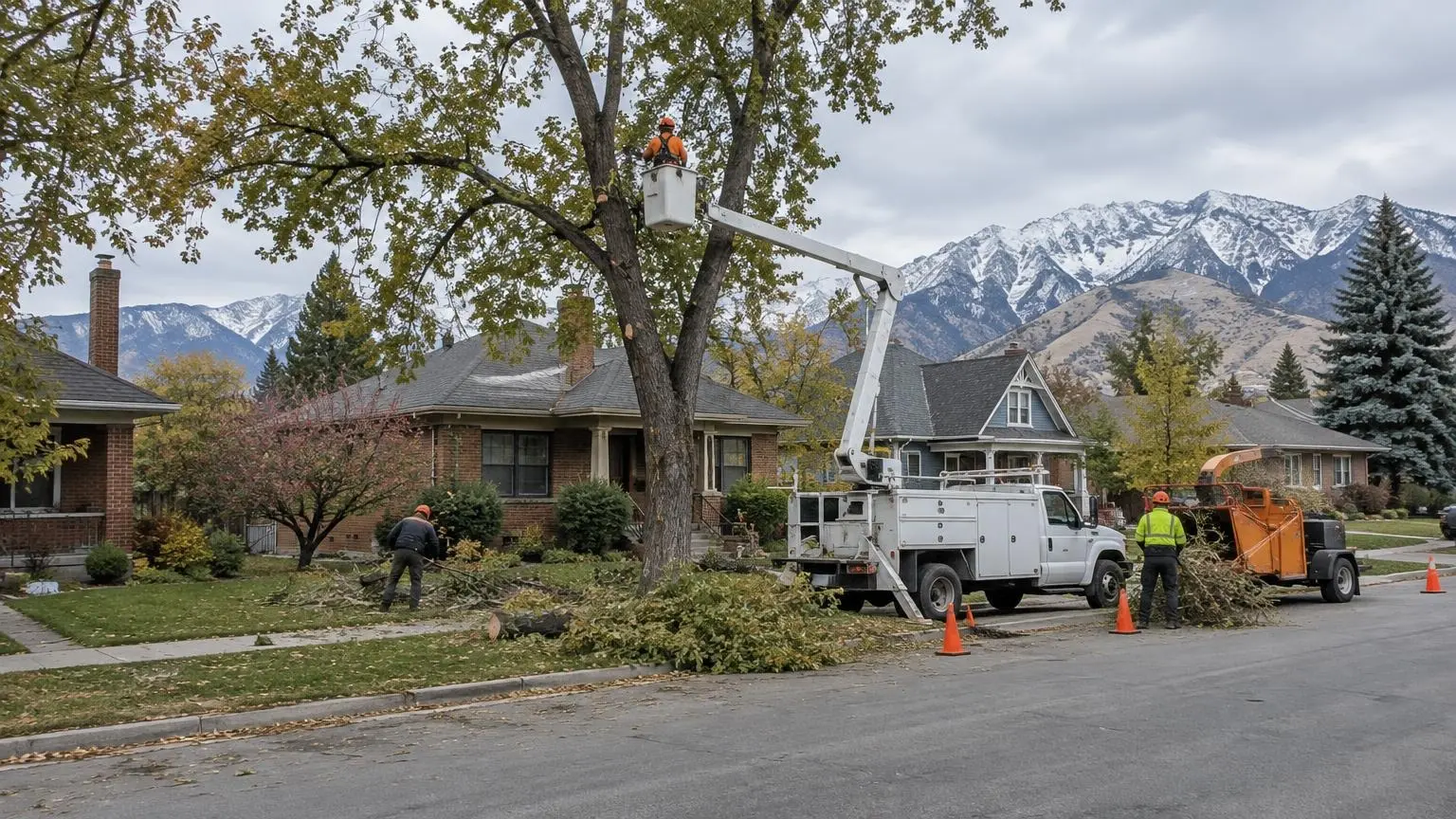
Tree work for the Salt Lake Valley
Tree Service in Salt Lake City, UT
Removal, pruning, stump grinding and storm cleanup, planned around canyon winds, heavy snow and the valley's alkaline soil.
- On-site quotes at no charge in Salt Lake Valley and Salt Lake County
- Prices put in writing before the crew arrives
- Cleanup terms written into the estimate
What Trees Face in a High-Desert City
Tree service in Salt Lake City starts with a simple fact: almost every shade tree here is growing somewhere it would not grow on its own. The valley floor is the old bed of Lake Bonneville, summers bring weeks of 90-degree days with little rain, and the soil is alkaline and full of lime. Big maples, elms, sycamores and spruces survive on irrigation, and stress shows up as dead tops, cankers, borer holes and pale leaves. Add snow loads in winter and the occasional windstorm off the mountains, and you get the jobs we are asked to do most: removing trees that have declined, pruning trees that have grown heavy over roofs, and cleaning up after a storm.
The September 2020 windstorm
On the morning of September 8, 2020, a windstorm with hurricane-force gusts hit northern Utah. Winds topped 100 mph in places, with a gust of 112 mph recorded at the University of Utah, and thousands of trees were toppled. Nearly 200,000 homes and businesses lost power, and the governor declared a state of emergency. Trees that fail in wind like that often show warning signs ahead of time: decay at the base, long limbs with little taper, or roots cut during old sidewalk or sewer work. Storms like that are rare, but they are a good reason to have a large tree near the house looked at before it is tested.
Snow, ice and early storms
Salt Lake City averages around 52 to 60 inches of snow a year depending on where it is measured, and the worst breakage comes from early or late storms that land on trees still in leaf. A wet October snow on a maple that hasn't dropped its leaves can tear out limbs that would have shrugged off the same snow in January. Utah State University Extension also notes that multi-stem evergreens such as junipers and arborvitae split under heavy snow, and that thin-barked trees like maple, ash, crabapple and fruit trees get sunscald on the southwest side of the trunk in winter. That dead bark is often where cytospora canker gets in.
Alkaline soil and iron chlorosis
USU Extension puts typical Utah soil pH at about 7.2 to 8.3, with lime that ties up iron. The result is iron chlorosis: leaves that turn yellow or nearly white while the veins stay green. Wet, poorly drained clay makes it worse. A tree that shows it year after year can lose limbs or die. Before anyone prunes or removes a yellowing tree, it's worth asking whether the watering schedule, not the tree, is the real problem.
Park strip trees and city rules
Most street trees in Salt Lake City belong to the city. Urban Forestry says a permit is required before removing, pruning or planting any tree in the public right-of-way, and it issues those permits only to ISA-certified arborists. The city also prunes park strip trees for safety and removes them as a last resort, so a call to (801) 972-7818 is often the cheapest fix. We check this first on every job that involves a tree near the street.
Power lines
Rocky Mountain Power serves Salt Lake City and asks homeowners never to prune or remove trees near power lines. Its crews prune for line clearance at no charge, and the company will arrange a free temporary disconnect of the service line to a house so tree work can be done safely. Call 1-888-221-7070 before any work near a line.
The Area We Cover
We work across Salt Lake City and the rest of the Salt Lake Valley. The east-side neighborhoods, including the Avenues, Federal Heights, Yalecrest and Sugar House, are full of older homes, many from before World War II, with mature trees, narrow side yards and detached garages off alleys, so most removals there come down in pieces. The Avenues sits on the foothill bench, where slopes and the wind off the mountains change how a tree is rigged. On the west side, in Rose Park, Glendale and Poplar Grove, lots are flatter and access is often easier, though big trees still stand close to houses and power lines. Out in the suburbs, trees planted when a subdivision was built have often grown large enough to need their first serious pruning.
- Tree Service in Salt Lake City, UT
- Tree Service in Millcreek, UT
- Tree Service in Holladay, UT
- Tree Service in Cottonwood Heights, UT
- Tree Service in Murray, UT
- Tree Service in Sandy, UT
- Tree Service in Draper, UT
- Tree Service in South Salt Lake, UT
- Tree Service in Midvale, UT
- Tree Service in Taylorsville, UT
- Tree Service in West Valley City, UT
- Tree Service in West Jordan, UT
- Tree Service in South Jordan, UT
- Tree Service in Riverton, UT
- Tree Service in Herriman, UT
- Tree Service in Bluffdale, UT
- Tree Service in Kearns, UT
- Tree Service in Magna, UT
- Tree Service in Emigration Canyon, UT
- Tree Service in Bountiful, UT
- Tree Service in Centerville, UT
- Tree Service in Farmington, UT
- Tree Service in Kaysville, UT
- Tree Service in North Salt Lake, UT
- Tree Service in Woods Cross, UT
- Tree Service in West Bountiful, UT
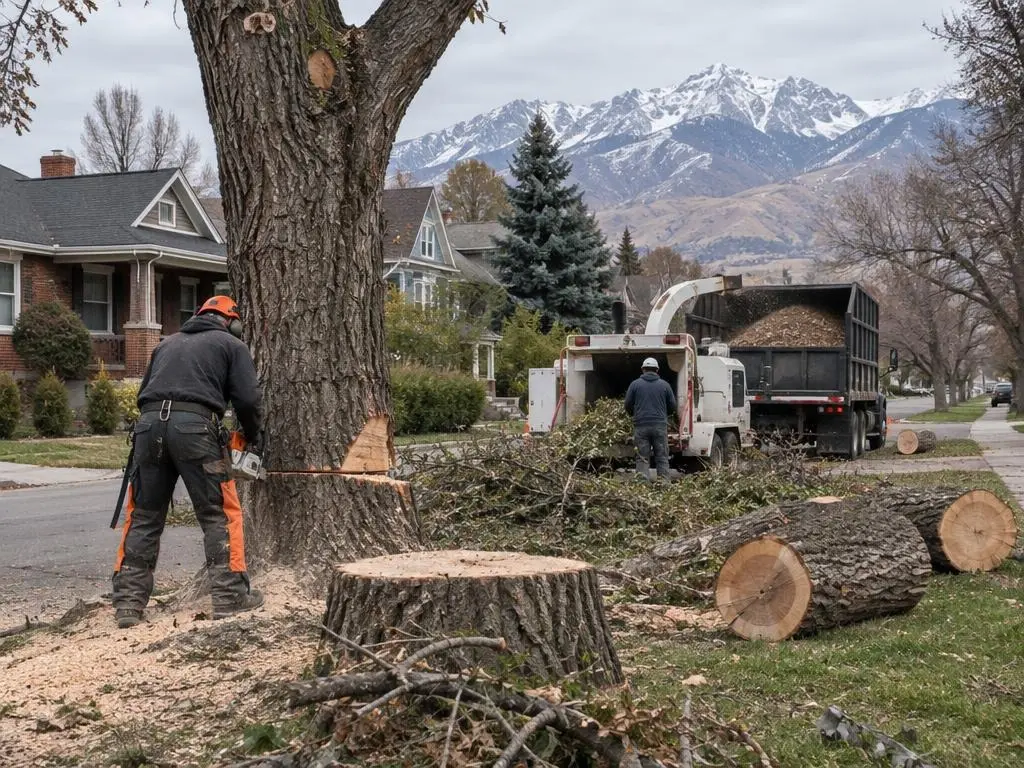
Why Homeowners Call Salt Lake City Tree Service Pros
City and utility questions answered first
If a tree is in the park strip or near a line, we tell you before quoting and point you to Urban Forestry or Rocky Mountain Power.
A diagnosis, not just a saw
We look for chlorosis, cankers, borer holes and decay, and say so when watering or pruning would solve the problem instead of removal.
A price you can hold us to
The written quote lists each tree, the work, the cleanup and the stump. Nothing is added without your written approval.
Wood handled your way
Logs stay in rounds, get cut to firewood length or go away with us. Clean chips can be left for mulch, which helps trees through dry summers.
Common Questions
Do I need a permit to remove a tree in Salt Lake City?
For a tree in the public right-of-way, usually the park strip between the sidewalk and the curb, yes. Salt Lake City Urban Forestry requires a permit before any removal, pruning or planting there, and issues those permits only to ISA-certified arborists. Urban Forestry's pages don't describe a removal permit for trees fully on private property, but HOAs and some subdivisions have their own rules, so check yours.
Who takes care of the tree in my park strip?
Salt Lake City Urban Forestry does. Call (801) 972-7818, Monday to Friday, 7:30 a.m. to 4 p.m. The city prunes for safety, obstructions and tree health and treats removal as a last resort; it generally won't remove a tree just because it lifts the sidewalk or is messy. If the city won't prune a tree to the extent you want, it says you can hire a certified arborist under a permit at your own cost.
How much does tree service cost in Salt Lake City?
National 2026 cost guides put the average tree removal at around $750 to $850, with small trees from about $200 and large trees $2,000 or more. Pruning averages $400 to $900 a tree, and stump grinding usually starts around $120 to $400 for the first stump. Access, what is under the tree and its condition change the price most. Your written estimate is the price.
Why are the leaves on my maple turning yellow with green veins?
That pattern is iron chlorosis, very common in Utah's alkaline, lime-rich soil. USU Extension says overwatering and poorly drained clay make it worse. Chelated iron applied to the root zone can help, but the long-term fix is often watering deeply and less often, or replacing the tree with an iron-efficient species.
A branch is resting on the wire to my house. Can you cut it?
Not while the line is live. Rocky Mountain Power asks people to call 1-888-221-7070; it can schedule a free temporary disconnect of the service line so the tree work can be done safely. Once the line is down or cleared, we can do the rest of the pruning or removal.
When is the best time to prune trees in Salt Lake City?
Late winter, while trees are dormant, suits most shade and fruit trees: you can see the structure, and fire blight cankers are easier to find. USU Extension advises against late-summer pruning because it can leave trees open to winter injury. Dead or broken limbs can come off any time.
Where can I get rid of branches and wood myself?
Salt Lake City's brown compost cart accepts tree branches, and the material goes to the city's compost facility. Residents with city curbside service also get one scheduled green waste pickup a year through Call 2 Haul. For a whole tree, it is usually simpler to have the brush chipped and hauled as part of the job.
Is there tree service near me on the west side or in the suburbs?
Yes. We cover all of Salt Lake City and the Salt Lake Valley, including Rose Park, Glendale, Poplar Grove and the south valley suburbs. Call or send the form with your address and a few photos, and we will set up a time to look.
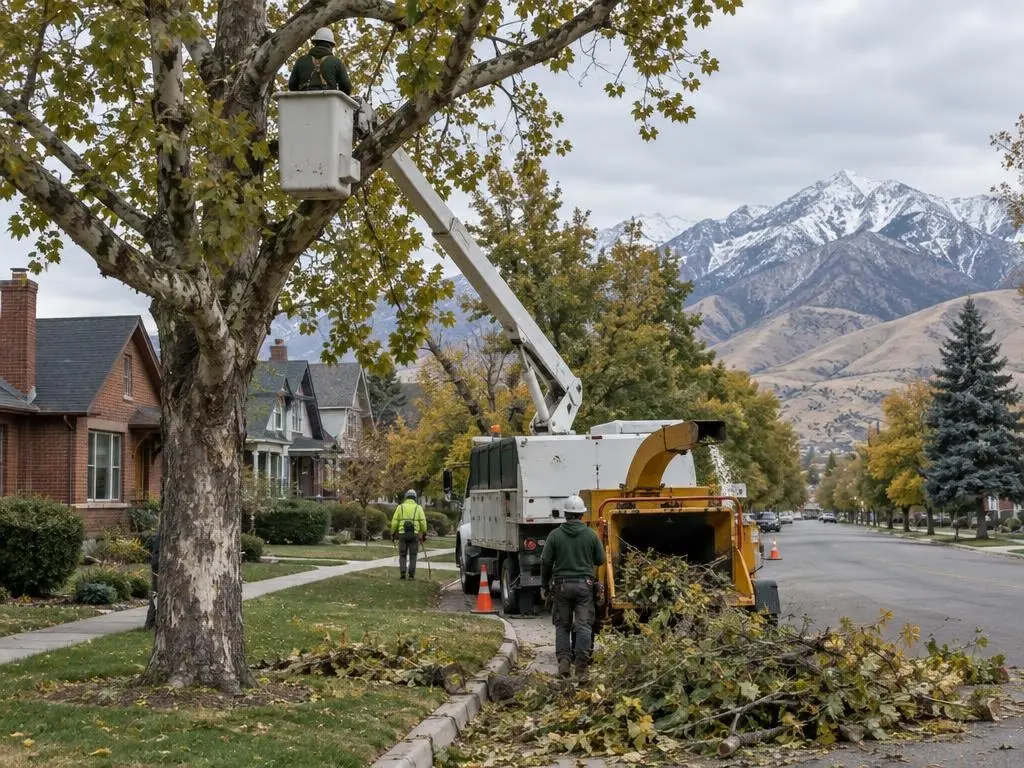
Tree Services in Salt Lake City
Six kinds of work cover nearly every tree problem on a Salt Lake Valley lot, from a dead spruce to an apricot that hasn't been pruned in ten years.
Tree Removal
Dead, declining, storm-cracked and oversized trees taken down in sections, with the wood and stump handled the way you choose.
Learn more →Tree Trimming & Pruning
Crown thinning, deadwood removal, roof and wire clearance, and structural pruning for young trees, done with proper cuts and no topping.
Learn more →Stump Grinding
Stumps ground below the surface so you can plant, lay sod or pour concrete, with chips left or hauled away.
Learn more →Emergency Storm Tree Service
Trees and limbs brought down by wind, heavy snow or ice, cleared from roofs, driveways and yards in order of danger.
Learn more →Fruit Tree Pruning
Apricot, peach, cherry, apple and pear trees pruned for structure, light and fruit, with fire blight and canker cut out cleanly.
Learn more →Tree Health Assessments
An on-site look at a tree that worries you: yellow leaves, dead tops, cankers, borer holes, cracks or a new lean, with plain advice on what to do.
Learn more →Get a Price on Your Tree Work
Free on-site estimates in Salt Lake City and across the Salt Lake Valley.